To pack a cooler for a tailgate, chill the cooler the night before, use block ice on the bottom and cubes on top, pack everything already cold, fill every air gap, and keep drinks and food in separate coolers so the food cooler stays shut. Food has to stay at 40°F or below, so the cooler that holds the raw meat gets opened as little as possible.
Before you leave: chill the cooler
A warm cooler spends its first bag of ice cooling itself down. The night before, put a bag of ice or a few frozen jugs in it and close the lid. Dump that ice in the morning and pack with fresh.
- Chill the contents too. Drinks and food go in cold from the fridge, never at room temperature. Every warm can melts ice.
- Freeze what you can. Water bottles and jugs frozen solid work as ice now and drinking water later. Marinated meat can go in frozen and thaw on the way.
- Park the cooler in the shade. Keep it out of a hot trunk as long as you can before you load up.

How to pack it, bottom to top
- Block ice or frozen jugs on the bottom. A solid block melts much slower than the same weight in cubes, because less of it touches warm air.
- The coldest-needs food next: raw meat in sealed bags or containers, low and right on the ice, so nothing drips onto ready-to-eat food.
- Then the rest of the food, with the things you'll need first (dips, cut fruit) on top.
- Cubed ice over and around everything, filling the gaps. Air is what warms a cooler; ice is what fills the space.
- Close it and leave it closed. Every lid lift lets cold air out.
A common rule of thumb is about twice as much ice as food by volume for a full day. For a few hours at the lot you can go lighter, as long as the food stays at 40°F or below. A cheap fridge thermometer in the food cooler tells you for sure.
Use two coolers: one for drinks, one for food
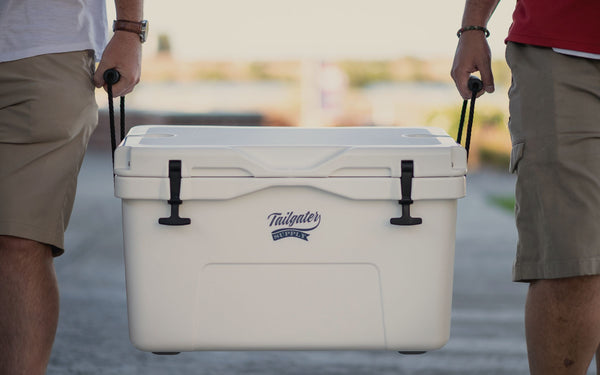
The drinks cooler gets opened every few minutes. The food cooler shouldn't. Splitting them is the single biggest thing you can do for food safety and for your ice.
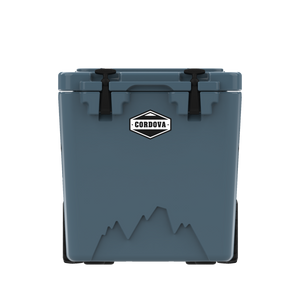
- Drinks cooler: cans on ice (many lots ban glass, and cans chill faster). Opened all day, so it melts first, and that's fine. A wheeled one like the Cordova 50 Outpost saves the carry from the car.
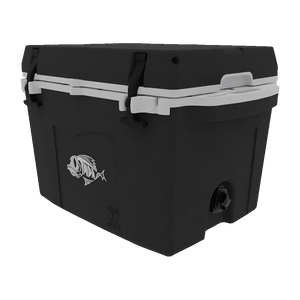
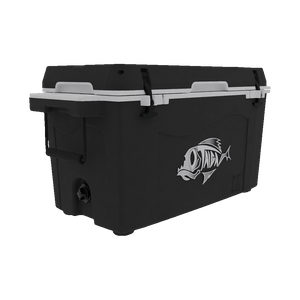
- Food cooler: raw meat and anything perishable. Opened only to cook and serve. A hard cooler like the Cordova 45 Basecamp or the Taiga 55 holds a crowd's worth.
- Keep a bag of cup ice separate from the ice that's been sitting around cans and meat packages.
At the lot
- Shade, and off the asphalt. Set the cooler in the shade of the car or canopy, on a mat or the tailgate. Hot pavement heats the bottom.
- Meltwater: leave it in the drinks cooler, since ice water chills cans fast. Drain the food cooler so packages don't sit in water.
- Two hours, then it goes. Perishable food that's been out of the cooler for 2 hours gets tossed, or 1 hour if it's over 90°F.
- Parked far away? A backpack cooler carries the drinks with both hands free: the Cordova Backcountry holds 24 cans, and our Tailgate Trekker holds 18 with ice.
- The cooler stays at the car. Most stadiums won't let a cooler through the gates under clear-bag rules, so plan to finish up before you walk in. See what stadiums allow.
How long will ice last in a cooler at a tailgate?
For a single game day, a decent hard cooler packed this way keeps ice well past kickoff. How long ice lasts depends on the cooler: Taiga says its hard coolers keep ice up to 7 days in ideal conditions and 5 or more in hot, real-world use. Pre-chilling, block ice and keeping the lid shut matter as much as the cooler.
Should you drain the water from a cooler?
In a drinks cooler, keep it: cold water around cans chills them fast and slows the melt. In a food cooler, drain it so packages don't soak and raw meat juice can't spread.
How much ice do you need for a tailgate?
A common rule of thumb is about twice as much ice as food and drinks by volume for a full day, less for a short tailgate. Bring one extra bag for cups, kept separate.
Should you use dry ice in a tailgate cooler?
We'd skip it. Dry ice gives off carbon dioxide as it warms, which isn't something you want building up in a closed car on the drive in, and it needs gloves to handle. Block ice and frozen jugs do the job for a game day.
Keep reading
The other half of the job is how to keep food hot at a tailgate. For a cold-weather game, see cold-weather tailgating, and before you go, check your stadium's cooler and glass rules in the stadium guides.
In this story